Ledger Hardware Wallet Setup: Complete Initial Security Guide
Ledger Hardware Wallet Setup establishes the security foundation protecting cryptocurrency holdings through proper initialization procedures and verification steps. The secure Ledger initialization process ensures device authenticity, creates access credentials, and establishes backup recovery capability before storing any private keys. Following security-focused setup practices prevents configuration errors that could compromise cold storage protection.
The Ledger cold wallet setup approach prioritizes security verification at each phase from unboxing through first transaction completion. Understanding why each step matters helps users implement proper procedures rather than rushing through configuration. This attention to detail during initial setup protects cryptocurrency holdings throughout years of hardware wallet operation across all supported coins.
This guide covers device authentication, credential configuration, recovery phrase protection, firmware verification, and transaction testing for complete crypto security establishment via USB-C or Bluetooth connection.
Device Unboxing Security
Device Unboxing Security begins the Ledger hardware wallet setup process with physical verification ensuring genuine, untampered device receipt. The anti-tamper check confirms packaging integrity from manufacturing while serial number verification validates device authenticity against Ledger records. Proper unboxing procedures protect against compromised devices that could threaten cryptocurrency holdings.
Unboxing should occur in a private environment where security seals and device display cannot be observed by others. Document any irregularities with photographs before proceeding with secure Ledger initialization.
Anti-Tamper Check
Anti-tamper check verification elements:
| Seal Type | Location | Genuine Condition |
|---|---|---|
| Holographic sticker | Box opening | Color-shifting intact |
| Security tape | Box edges | No "VOID" visible |
| Plastic wrap | Outer box | Factory-applied |
| Device seal | Around hardware | Clear wrap unbroken |
| Card envelope | Recovery cards | Sealed unopened |
| Cable seal | USB-C cable | Factory packaging |
Anti-tamper check identifies repackaged or previously opened devices before Ledger cold wallet setup begins. Any seal irregularity warrants support contact before proceeding with cold storage configuration.
Serial Number Verification
Serial number verification authentication process:
- Locate serial on device back label
- Compare with serial on packaging label
- Document serial for future reference
- Serial validates during Ledger Live genuine check
- Matching serials indicate authentic device
- Mismatched serials require investigation
- Support can verify against manufacturing records
Serial number verification ensures received device matches packaging records. This complements electronic authentication during secure Ledger initialization for secure element confirmation unlike Trezor or KeepKey verification processes.
PIN and Passphrase Setup
PIN and Passphrase Setup creates access control protecting Ledger hardware wallet setup from unauthorized use. The strong PIN choice establishes primary access barrier while optional passphrase adds advanced protection layer for high-value holdings. Proper credential configuration prevents unauthorized access to private keys.
PIN entry occurs exclusively on the device display, ensuring credentials never exist on connected computers where capture could occur. The secure element enforces PIN requirements without external bypass capability for crypto security.
Strong PIN Choice
Strong PIN choice selection criteria:
PIN security requirements:
- Choose between 4-8 digits in length
- Longer PINs provide stronger protection
- Avoid sequential numbers (1234, 5678)
- Avoid repeated digits (0000, 1111)
- Avoid personal dates (birthday, anniversary)
- Avoid obvious combinations (address, phone)
- Create unique code not used elsewhere
- Memorize without written storage
- Enter only on device display
- Three incorrect attempts wipes device
Strong PIN choice creates effective access barrier for Ledger cold wallet setup. The cold wallet protection begins with properly selected PIN credentials via USB-C connection.
Optional Passphrase
Optional passphrase advanced protection features:
| Feature | Without Passphrase | With Passphrase |
|---|---|---|
| Security level | Standard | Enhanced |
| Access requirement | PIN only | PIN + passphrase |
| Recovery needs | Phrase only | Phrase + passphrase |
| Hidden wallets | Not available | Possible |
| Complexity | Simple | Requires management |
| Recommended for | Most users | High-value holdings |
Optional passphrase creates additional wallet accessible only with specific passphrase entry. This advanced feature requires careful management to avoid permanent access loss during secure Ledger initialization for all supported coins.
Recovery Seed Security
Recovery Seed Security represents the most critical element of Ledger hardware wallet setup determining long-term cryptocurrency accessibility. The offline backup approach ensures phrase security through physical-only recording while safe storage location selection protects against theft and disaster. Recovery seed handling determines whether holdings remain recoverable.
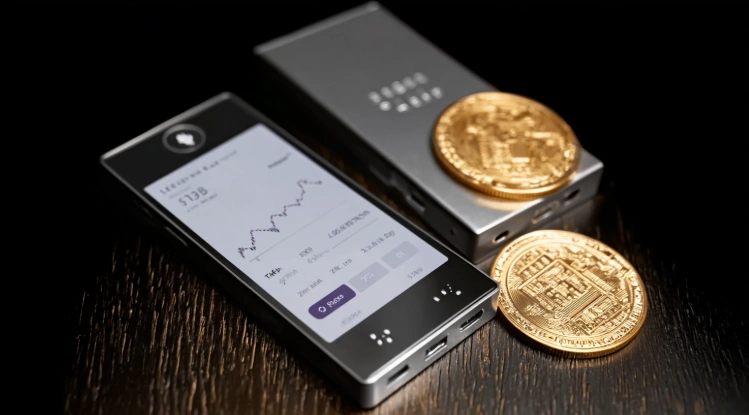
The 24-word phrase provides complete wallet reconstruction capability across any compatible device. This power requires corresponding protection against unauthorized access for private keys backup.
Offline Backup
Offline backup creation requirements:
- Device generates phrase using hardware RNG
- Words display only on hardware wallet screen
- Computer or phone never sees phrase
- Write words on provided recovery cards
- Record exact spelling and sequence
- Device prompts verification of selected words
- Enter words when requested to confirm accuracy
- Phrase stored encrypted in secure element
- No digital copy exists anywhere
Offline backup ensures recovery phrase never exists on internet-connected devices. This isolation prevents malware capture during Ledger cold wallet setup for crypto security via Bluetooth or USB-C systems.
Safe Storage Location
Safe storage location considerations for recovery phrase:
| Location Type | Security Level | Durability | Accessibility |
|---|---|---|---|
| Home safe | High | Varies | Convenient |
| Bank safe deposit | Very High | High | Limited hours |
| Hidden location | Medium | Varies | Convenient |
| Trusted person | Medium | N/A | Variable |
| Metal backup | High | Very High | As chosen |
| Multiple copies | Distributed | Varies | Redundant |
Safe storage location balances security against accessibility for cold storage recovery needs. Geographic distribution protects against localized disasters unlike Trezor or KeepKey backup approaches.
Firmware Verification
Firmware Verification confirms device software integrity before storing cryptocurrency during Ledger hardware wallet setup. The Ledger Live check cryptographically validates secure element authenticity while signature validation ensures firmware originates from Ledger. Verification should complete before depositing any funds.
Firmware verification provides confidence that device operates as intended without unauthorized modification. Skipping verification could result in using compromised hardware for private keys storage.
Ledger Live Check
Ledger Live check verification process:
Genuine check workflow:
- Download Ledger Live only from ledger.com
- Verify installer checksum against published values
- Install and launch application
- Connect device via USB-C cable
- Follow genuine check prompts
- Cryptographic attestation verifies secure element
- Green checkmark confirms authentic device
- Failed check indicates potential counterfeit
- Do not proceed if verification fails
- Contact support for failed genuine checks
Ledger Live check provides cryptographic proof of device authenticity during secure Ledger initialization. The verification confirms both hardware and firmware integrity for cold wallet protection.
Signature Validation
Signature validation firmware protection:
| Security Layer | Protection | Verification |
|---|---|---|
| Digital signature | Authenticity | Ledger private key |
| Hash verification | Integrity | SHA-256 checksum |
| Secure element check | Hardware validation | On-device verification |
| Version control | Rollback prevention | Monotonic counter |
| Chain of trust | Distribution security | End-to-end verification |
Signature validation ensures only authentic Ledger firmware executes on devices. The secure element refuses unsigned or invalid firmware regardless of installation method for crypto security across all supported coins.
First Transaction Test
First Transaction Test validates complete Ledger hardware wallet setup functionality before committing significant funds. The send small amount approach tests transaction flow with minimal risk while verify on device confirms hardware display accuracy. Testing establishes confidence in configuration.
Testing with minimal amounts prevents costly errors from configuration problems. Successful test confirms ready status for regular cold storage usage.

Send Small Amount
Send small amount test procedure:
- Fund wallet with minimal test amount
- Create transaction in Ledger Live
- Review transaction details carefully
- Confirm address matches destination
- Verify amount is correct
- Approve transaction on hardware wallet
- Compare device display to application
- Sign transaction with button confirmation
- Monitor blockchain confirmation
Send small amount validates Ledger cold wallet setup completion. The first transaction test confirms all components function correctly for private keys operations via USB-C or Bluetooth.
Verify on Device
Verify on device confirmation elements:
| Display Element | Verification Purpose | Action Required |
|---|---|---|
| Recipient address | Correct destination | Compare to intended |
| Amount | Correct value | Verify expectation |
| Fee | Reasonable cost | Assess appropriateness |
| Network | Correct blockchain | Confirm asset type |
Verify on device confirms hardware wallet displays match application requests. This verification prevents transaction manipulation completing secure Ledger initialization for crypto security.
For secure connection guidance, see our Ledger Device Secure Connection guide. For complete checklist, visit Ledger Hardware Wallet Setup Checklist.